
Blog
What Is Paint Correction?
What is paint correction? Machine polishing that removes defects from your clear coat rather than hiding them, what it costs, and when a car actually needs it.
Paint correction, Pricing
Paint correction is machine polishing that removes a microscopic layer of your clear coat in order to level out the defects sitting in it. Swirl marks, oxidation, light scratches and paint transferred from another vehicle all live in that clear layer. Taking the surface down to the bottom of them is the only thing that genuinely removes them, as opposed to filling them with something that washes out in three weeks.
That is the whole idea, and the word correction is doing real work in it. The paint ends up corrected. It is not coated in a product that masks the problem until the next rain.
What it removes, and what it will not
Most of what makes an older car look tired is in the clear coat, which is why correction changes a car so much more than people expect.
It removes:
- Swirl marks, the fine circular scratches you only see in direct sun
- Oxidation, the chalky dullness on paint that has lived outside
- Light scratches you cannot catch a fingernail in
- Paint transfer from another car, a post or a garage wall
- Water spot etching, where minerals have bitten into the surface
- Buffer trails left by whoever polished it badly last time
It will not remove:
- Anything deep enough to catch a fingernail in. That has gone through the clear coat, and polishing cannot put clear coat back
- Rock chips, for the same reason
- Dents, creases or anything that has moved the metal
- Scratches in the primer or down to bare metal
The fingernail test is the one worth knowing. Run a nail lightly across the scratch. If it catches, the damage is through the clear and no amount of polishing will fix it. If it does not, there is a good chance it comes out.
One step or two, in plain terms
A one-step is a single polishing pass with a finishing compound. It lifts gloss, evens out the look and takes out the lightest haze. It is the right call on a newer car, a well-kept one, or a car being prepared for sale where the goal is to look its best rather than be perfect.
A two-step starts with a cutting compound through every panel, which is the stage that actually removes defects, then follows with a finishing polish to bring the shine back up. Cutting leaves its own fine marks, so the second step is not optional. A one-step job sold as a two-step is cutting without refinishing, and you can see it in the sun.
Two-step is what a neglected car, a dark-coloured car, or any car going under a ceramic coating needs. A coating seals in whatever is underneath it for the life of the coating, which is why correction comes first and never after.
How much does paint correction cost?
A paint correction costs between $252 and $900, and where you land in that depends on the size of the vehicle and whether the paint needs one polishing step or two.
A one-step paint enhancement is $252 for a sedan, $300 for a mini SUV and $360 for a full-size SUV or four-door truck.
A two-step correction runs $300 to $750 on a sedan and $360 to $900 on a full-size SUV.
The two-step is quoted as a range and everything else on our price list is a flat rate. That is not hedging. It is the one job here whose price genuinely depends on the car, because how far the defects go into the clear coat decides how many passes it takes, and nobody can tell that from a phone call. Send a photo taken in direct sun and we can usually place you in the range before we see the car.
Correction is sold alongside a full exterior detail rather than on its own. Polishing paint that still has contamination bonded to it grinds that contamination into the surface, so the decontamination wash is part of the work rather than an upsell.
How to tell whether your car needs it
Pull the car into direct sunlight, or put a phone torch close to the paint in a dark garage, and look at the panel from a low angle rather than straight on.
- Fine circles that appear to rotate as you move your head. Swirl marks, almost always from washing. This is the single most common defect and the one correction fixes most dramatically.
- A flat, chalky look on a colour that used to be deep. Oxidation. Common on reds and blacks and on anything that lives outside.
- The reflection of an edge looks fuzzy rather than sharp. The clear coat is scattering light. That is correctable.
- Reflections are already crisp. Save your money. A car with clean, sharp reflections does not need correction, and we will say so.
It is not waxing, coating, or paint protection film
These get used interchangeably and they are four different things.
Polishing and waxing are not the same thing. A wax or sealant adds a sacrificial layer on top of the paint. It makes the car shine for a few weeks and it hides very little. Correction takes material away rather than adding it.
Ceramic coating is a protective layer bonded to the paint. It is what you do after correction, not instead of it. It makes washing easier for years but it will not improve the surface under it.
Paint protection film is a physical layer that absorbs rock chips. Correction does nothing for chips and film does nothing for swirls.
Correction is the only one of the four that changes the paint itself.
Is it worth paying for?
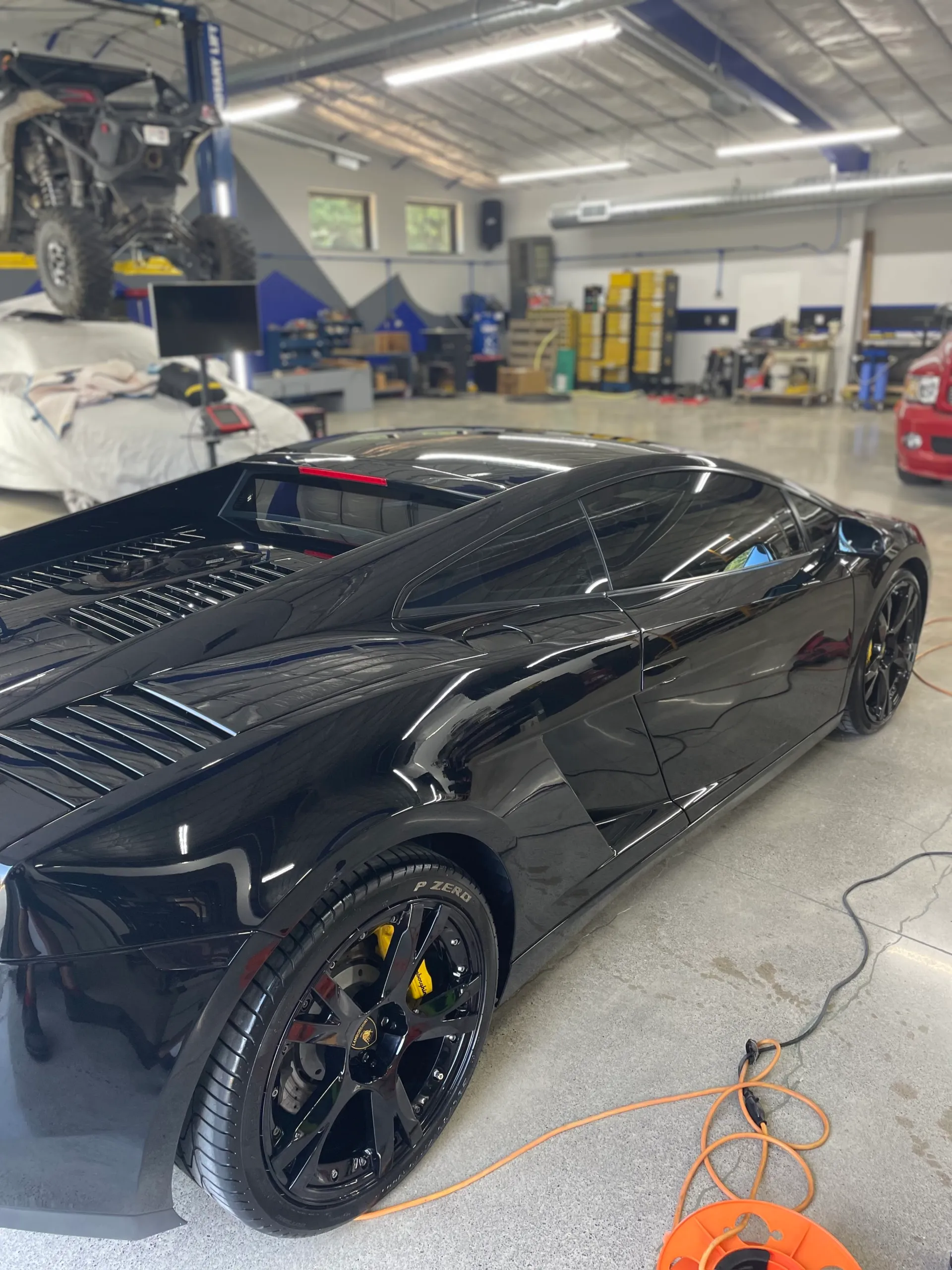
If the car is dark-coloured and has been through automatic car washes, yes, and the difference will be larger than you expect. Swirl marks are most of what makes a black car look old.
If you are about to put a ceramic coating on it, it is not optional. Coating over defects locks them in for years.
If you are selling, a one-step is usually the better value than a two-step. You are buying the way it photographs and the way it looks on a forecourt, not perfection.
If the paint is already sharp in the sun, keep your money. We would rather tell you that than take it.
Want an opinion before you spend anything? Send a photo of the paint taken in direct sun to 360-335-4468 and we will tell you honestly which level it needs, including when the answer is neither. The buff and polish page has the method and the full price table.
Read next
More on keeping a car right
Do You Tip Car Detailers?
Do you tip car detailers? Usually yes if an employee did the work, rarely if the owner did. How to tell which you booked, and what to give in each case.
Detailing Is an Investment
When we talk about professional auto detailing, we're talking about something far more comprehensive. It's easy to see detailing as just an expensive car wash,
A Guide to Mobile Car Detailing
Looking for professional mobile car detailing in Vancouver, WA? Tan’s Auto Detailing offers expert interior and exterior cleaning, waxing, and ceramic coatings.
Book it instead of doing it
Call or text 360-335-4468. Flat rates, and we come to you.